
The ADA “Religious Exemption” and Disability Exclusion

Let’s start with the numbers, because they tell astory.
According to the CDC, 26 percent of adults in the United States have some type of disability. That is one in four people. We are the largest minority group nationally as well as globally, with approximately 1,3 billion people living with significant disabilities worldwide (16% of the world population).
Yet, look around your sanctuary on Sunday morning. Does the congregation reflect that reality? Statistically, the answer is no. Research consistently shows that people with disabilities are significantly less likely to attend religious services than those without. For those that do seek out a faith community, studies have shown that as many as one-third of families step away from fellowship, because they do not feel supported or welcomed. For families with children on the autism spectrum, the odds of never attending church are nearly double that of neurotypical families.
We are the missing majority.
The question we must ask is why. Why is a demographic that comprises a quarter of the population so visibly absent from the body of Christ?
A Tale of Two Worlds
I recently closed a chapter of my life that spanned over two decades trying to answer questions like this. I retired from my from a 22-year career in the federal government. During my career, I worked across multiple agencies, primarily focusing on the intersection of health, disability, and employment. a Senior Policy Advisor at the U.S. Department of Labor’s Office of Disability Employment Policy (ODEP)—gave me a front-row seat to the evolution of disability rights in America.
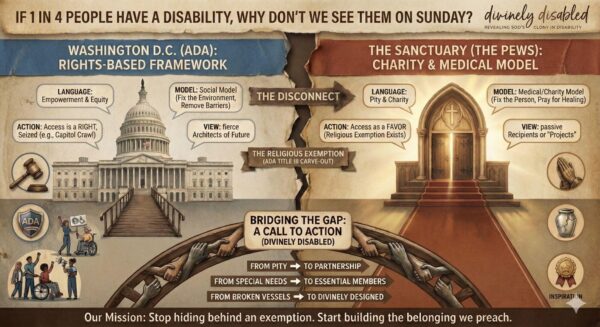
In the halls of Washington, DC, the conversation around disability is defined by rights, equity, and the Americans with Disabilities Act (ADA). It is a language of empowerment.
But on Sunday mornings, when I stepped out of the policy arena and into the sanctuary, the language often shifted dramatically. It became a dialect of pity. One that still exists today.
There is a profound disconnect between how our government legislates inclusion and how our churches practice it. This gap between the ADA and the altar is where I believe the next faith and disability movement must take place.
The View from DC: Rights Fought For
At ODEP, the framework was clear: Disability is a natural part of the human experience. The focus was never on “fixing” the person but on fixing the environment. This is known as the Social Model of Disability. When a barrier existed—whether physical, digital, or attitudinal—the mandate was to remove it.
In DC, advocacy is effective because it is grounded in the legal reality that access is a right, not a favor. But we must remember that this right wasn’t given; it was seized.
In March 1990, when the ADA was stalled in Congress, disability rights activists decided they had waited long enough. Over 1,000 protesters marched to the U.S. Capitol, where 60 activists left their wheelchairs and crutches at the bottom of the Capitol’s massive stone steps and began to crawl up them.
Among them was 8-year-old Jennifer Keelan-Chaffins. Diagnosed with cerebral palsy, she pulled herself up the stone steps, declaring to the cameras, “I’ll take all night if I have to.”
That moment, known as the Capitol Crawl, forced the world to see the physical reality of exclusion. It proved that people with disabilities were not passive recipients of care, but fierce architects of their own future.
The View from the Pews: The Charity Trap
In contrast, the church often operates under an unspoken Medical Model or Charity Model of disability.
Instead of ramps and reasonable accommodations, we are often met with prayers for healing that we didn’t ask for, or we are held up as inspirations simply for showing up. The theology frequently implies that disability is a tragic deficit—a brokenness that needs to be corrected, healed, or fixed before true belonging can occur.
“In DC, I was a policy advisor and an expert. In the pew, I have often been viewed as a project or a ministry recipient rather than a ministry partner.”
The Uncomfortable Truth: Why Are Churches Exempt from the ADA?
Why is there such a chasm between the marble steps of the Capitol and the carpeted aisles of the sanctuary? Why is advocacy effective in DC but pity-based in the pews?
Part of the answer lies in an uncomfortable historical reality: The church fought for the right to exclude us.
During the drafting of the ADA, religious lobbyists representing major Christian denominations argued that mandatory accessibility would be too costly and constituted government intrusion. They succeeded.
The result was a significant carve-out known as the “religious exemption.” To this day, religious entities are exempt from Title III of the ADA. Houses of worship are not legally required to install ramps, elevators, or accessible restrooms.
This created a profound moral irony. Institutions whose texts preach welcoming the stranger fought for the legal right to close the door on them.
Every other segment of American society has been forced—through legislation and relentless advocacy—to design, build, and operate in ways that include people with disabilities. The advocacy and contributions of the disability community have bettered our nation. Both Harriet Tubman and Franklin D. Roosevelt lived with disabilities. Furthermore, disability advocacy has repeatedly created solutions intended for a few—such as curb cuts, audiobooks, and closed captioning—that ended up helping everyone (often called the Curb Cut Effect).
The church, however, has largely legally insulated itself. Not only has this fostered an environment where disabled people are frequently seen as visitors, but I believe it has also left the church unable to fulfill its biblical mandate.
Bridging the Gap: A Covenant of Belonging
My mission now, through Divinely Disabled (both my website and book), is to bring the rigor of ODEP policy into the relational warmth of the sanctuary. We need a covenant of belonging: not legislation, but a new theology of access, inclusion, and belonging
We need churches to move from
- operating from a perspective of pity versus partnership
- seeing us as having special needs to considering us essential members
- viewing us as broken vessels to seeing us as divinely designed
The government taught me how to fight for a seat at the table. The church is where I want to help set that table—not just for me, but for everyone. We shouldn’t need a law to tell us to open our doors. It is time to stop hiding behind an exemption from 1990 and start building the belonging we preach.
Frequently Asked Questions
Why are churches exempt from the ADA? Churches are exempt from Title III of the Americans with Disabilities Act (ADA) due to a “religious exemption” negotiated during the bill’s drafting in 1990. Religious organizations argued that mandatory compliance would be too costly and an intrusion of state into church affairs.
What is the difference between the Medical Model and the Social Model of Disability? The Medical Model views disability as a problem or deficit in the person that needs to be fixed or cured. The Social Model views Disability as a mismatch between a person’s abilities and their environment, focusing on removing social and environmental barriers (physical or attitudinal) to create access.